Wellhead
This page contains information about a typical Venetian wellhead. For information on wellheads as a whole, see Wellheads
A wellhead, vera da pozzo in italian, is the only exposed component of the Venetian well system. Some local names include anello, corona, sponda, cinta, parapetto, spalletta or bocca di pozzo. The wellhead served as a cap on the well to prevent debris from falling in and contaminating the fresh water supply. As the well system is no longer a source of fresh water for Venetians, the Venetian Wellhead is now considered public art and an aspect of the city's historical and artistic value. See Public art preservation.
History
History of Water Provision in Venice
The first wellheads were created for shallow wells in the Lido that used the Lido's natural sand dunes to filter rainwater. The first cistern wellheads in the city of Venice were created in the eleventh century. As the cistern system developed, more wells and wellheads were created, with eventually more than 6,000 wellheads in use in the 19th century. When the Venetian aqueduct was constructed in 1884, the wellheads fell out of use and the city of Venice began sealing them up. By 1930, all wellheads in Venice were sealed, destroyed, or removed. For more information see Wellheads.
Retrieving Water
Churches were once responsible for locking and unlocking the well at certain times of the day. This was to prevent just anyone from retrieving water from the well at any given time. In order to retrieve water from the well, Venetians typically used ropes to haul buckets of water over the lip of the wellhead. These ropes left grooves in the material of the wellhead as seen below. Some private wellheads had a pulley system installed to retrieve water without damaging the wellhead.
-
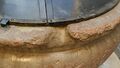 The mark resulted from retrieving water with a rope
 -
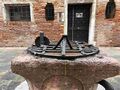 A wellhead lid with a pulley attached to lower a bucket with


Design
A typical wellhead has a platform, main body and lid. The platforms are usually short, but can be set higher above ground level in order to prevent salt water from contaminating the well during tidal flooding [1] . A typical wellhead has an overall cylindrical or square shape. Often the shape of the base and the shape of the rim are different. The shape of the base is consistently circular while the shape of the rim varies between circular, square, hexagonal and octagonal. The typical wellhead features inscriptions and carvings of saints or family crests. The artistic and structural design of each wellhead is indicative of the art period it was built in.
Material
A wellhead is traditionally constructed with either Istria stone, Red Verona Marble or White Verona Marble. To see the percentage of wells made of each stone, see Wellheads. Up until the 13th century, Venetians primarily constructed the wellheads with Aurisina limestone. Aurisina is a limestone that usually has a grayish color and granular appearance. It stopped appearing in wellheads around the end of the 13th century, when Istria Stone caused it to become obsolete. There are very few remaining wellheads made of Aurisina.
Towards the end of the 13th century, carvers began using Istria limestone and Verona stone [2] . Istrian stone makes up a majority of wellheads in Venice and is a type of limestone: gray-green or yellow in color [3] . Exposure to the atmosphere for long periods causes Istrian stone to become whitish in color through a process called “whitewashing” [4] . This makes Istrian Stone susceptible to exfoliation, a process where thin layers peel off from the stone’s surface, like sheets, weakening the structural integrity of the material [5] .
Verona Stone, another common material Venetians used to construct wellheads and fountains, is a sedimentary rock containing limestone and various fossils [6] . It can have a reddish or whitish hue, depending on the carbon compounds it contains [7] . Red Verona Stone noticeably differs from Istrian Stone due to its red color. White Verona Stone, while similar in appearance to Istrian Stone, is distinguishable by its heterogeneous appearance, or variation within the stone [8] .
-
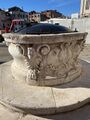 A wellhead made of Istrian Stone
 -
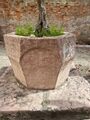 A wellhead made of Red Verona Marble
 -
 A wellhead made of White Verona Stone


Styles
Over the eight hundred years that Venice relied on the cistern system, the style of wellheads varied greatly. The first wellheads ever used in Venice were reused pieces of marble from other buildings. Then, the Venetians started making their own wellheads, which were relatively simple. As the years progressed, the wellheads became more ornate before becoming simpler until they were replaced.
Many early wellheads were reworked pieces of marble from classical Greek and Roman structures. These included column shafts, altars, memorial stones, cinerary urns, and other pieces.<ref>Rizzi,1981</ref>. These wellheads were used on the Lido before the construction of the cisterns.
In the eighth to tenth century, Carolingian style wellheads became popular. This style was heavily influenced by the architecture created under Charlemagne's rule. Carolingian wellheads tend to be either cubes or cylinders. These are also rare since they fell out of use before the cistern system was invented.
The Byzantine style was heavily influenced by Christian architecture and Venice's close contact with the Byzantine Empire in the 11th to 13th centuries. Wellheads built in this style were either freestanding cylinders or cylinders surrounded by columns. They are characterized by their elaborate design, often featuring twisted columns and animals<ref>Venetian Wells, n.d.</ref>.
INCLUDE IMAGE OF BYZANTINE STYLE WELL
The Gothic style dominated Venetian art from the 14th to 15th centuries. Gothic wellheads were intricately designed to look like the top of columns, with arched sides and decorative corners. This style is common because it was popular when the city of Venice started building wells in every campo.
INCLUDE IMAGE OF GOTHIC STYLE WELL
The Renaissance style originated in Italy, characterized by a renewed interest in classical art; it was used primarily in the fifteenth and sixteenth century. This style's polygonal and cylindrical wellheads have more naturalistic elements including flowers and leaves. This style is also common since it was popular when the city of Venice was building wells in every campo.
INCLUDE IMAGE OF RENAISSANCE STYLE WELL
The Baroque style was slightly different from that of the Renaissance style. Wellheads at this time were round, simpler, few decorations and emphasis on heavy spaces. Wellheads built during this time lacked a sort of relevance due to the decline of the Venetian republic during the seventeenth and eighteenth centuries.
INCLUDE IMAGE OF BAROQUE STYLE WELL
Wellheads built during the nineteenth and twentieth centuries are often significantly larger or smaller than those built during any of the aforementioned era. These are often called Neo-classical wellheads. They are not much more than simple stone cylinders.
Another wellhead style of note is the traditional wellhead. Traditional wellheads were most common in the 14th to 16th centuries, but were around for most of the time that the cisterns existed. They are identifiable by their circular base and polygonal rim with arches carved into the sides.
Lid
The Lid of a wellhead is almost always circular in shape and either flat or convex on the top. The most common material for lids is iron, but stone, wood, and bronze lids also exist. Some wellheads have lost their lids, and many have been filled in with concrete.
-
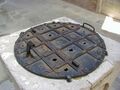 A wellhead that has a metal lid
 -
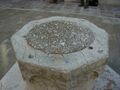 A wellhead with no lid that has been filled in with concrete
 -
 A wellhead in Chioggia that has a statue as the lid


Serving Nature
In the past, these wellheads served as access points to fresh water for not only the human population of Venice, but the animals as well. Small, bowl-shaped indentations were made in the platforms of some wellheads. These indentations served as a source of fresh drinking water and as baths for the local wild life.
See also
References
Bibliography
NULL