Fountain: Difference between revisions
No edit summary |
|||
| (10 intermediate revisions by the same user not shown) | |||
| Line 1: | Line 1: | ||
''This page contains information about a typical Venetian fountain. | ''This page contains information about a typical Venetian fountain. For a list of fountains, see [[Fountains]]'' | ||
[[ | |||
A fountain, ''fontana'', is a public drinking water system in Venice. There are fountains all across the city that either run continuously or use a push button or valve to operate. Among the 228 fountains in Venice, around half of them are functional. The Venetian fountain serves not only a practical purpose, but also as a unique aspect of Venetian public art.'' See [[Public art preservation]].'' | |||
[[File:A Venetian fountain.JPG|200px|thumb|right|A Venetian fountain]] | |||
A fountain | |||
== Types of Fountains == | == Types of Fountains == | ||
In the Venetian Lagoon, there are multiple types of fountain according to their design and shape. These types include Delfini, Puglia, Alto, Ott. Basso, San Marco, Cylindro, Pozzo, Tubo, and Neri. Some of them have solid rectangular shape with some fancy designed lid at the top (i.e. Neri), while some of them are just a simple tube with a spout (i.e. Tubo). Additionally, these fountains have different faucet design with mostly lion heads. | In the Venetian Lagoon, there are multiple types of fountain according to their design and shape. These types include Delfini, Puglia, Alto, Ott. Basso, San Marco, Cylindro, Pozzo, Tubo, and Neri. Some of them have solid rectangular shape with some fancy designed lid at the top (i.e. Neri), while some of them are just a simple tube with a spout (i.e. Tubo). Additionally, these fountains have different faucet design with mostly lion heads. | ||
| Line 18: | Line 10: | ||
</gallery> | </gallery> | ||
== | == Materials == | ||
The majority of the fountains in the Venetian Lagoon are metal and only a few of them are stone. Because of this, many fountains suffer from natural damage such as algae and especially rust. The location of Venice exacerbates this problem even more. The vast majority of the metal fountains are cast iron. These metal fountains are painted to cover the metal surface to avoid rust, but the paints wear out from times to times leaving the majority of metal fountains in the Lagoon susceptible to rust. Some stone fountains are made out of Istria stone and marble and typically built in a later period. | The majority of the fountains in the Venetian Lagoon are metal and only a few of them are stone. Because of this, many fountains suffer from natural damage such as algae and especially rust. The location of Venice exacerbates this problem even more. The vast majority of the metal fountains are cast iron. These metal fountains are painted to cover the metal surface to avoid rust, but the paints wear out from times to times leaving the majority of metal fountains in the Lagoon susceptible to rust. Some stone fountains are made out of Istria stone and marble and typically built in a later period. | ||
<gallery> | <gallery> | ||
Latest revision as of 12:44, 11 December 2025
This page contains information about a typical Venetian fountain. For a list of fountains, see Fountains
A fountain, fontana, is a public drinking water system in Venice. There are fountains all across the city that either run continuously or use a push button or valve to operate. Among the 228 fountains in Venice, around half of them are functional. The Venetian fountain serves not only a practical purpose, but also as a unique aspect of Venetian public art. See Public art preservation.

Types of Fountains
In the Venetian Lagoon, there are multiple types of fountain according to their design and shape. These types include Delfini, Puglia, Alto, Ott. Basso, San Marco, Cylindro, Pozzo, Tubo, and Neri. Some of them have solid rectangular shape with some fancy designed lid at the top (i.e. Neri), while some of them are just a simple tube with a spout (i.e. Tubo). Additionally, these fountains have different faucet design with mostly lion heads.
-
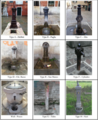 Types of Fountain

Materials
The majority of the fountains in the Venetian Lagoon are metal and only a few of them are stone. Because of this, many fountains suffer from natural damage such as algae and especially rust. The location of Venice exacerbates this problem even more. The vast majority of the metal fountains are cast iron. These metal fountains are painted to cover the metal surface to avoid rust, but the paints wear out from times to times leaving the majority of metal fountains in the Lagoon susceptible to rust. Some stone fountains are made out of Istria stone and marble and typically built in a later period.
-
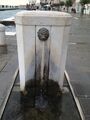 Stone fountain with algae
 -
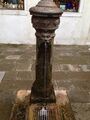 Metal fountain with rust and algae


See also
References