Bell tower: Difference between revisions
V26e.bells (talk | contribs) No edit summary |
V26e.bells (talk | contribs) No edit summary |
||
| Line 31: | Line 31: | ||
=== Romanesque === | === Romanesque === | ||
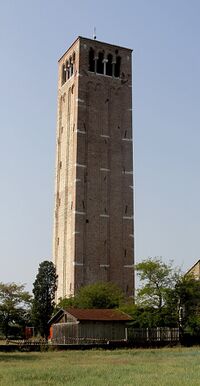
The Venetian Romanesque style, which is more specifically called First Romanesque, is an architectural style of medieval Europe that developed and became predominant in the 11th and 12th century. The style developed in the Lombard region, which at the time, encompassed all of Northern Italy. In Venice, Romanesque bell towers are characterized by their simplicity and strength, possessing thick brick walls and commonly lacking exterior adornments. The exteriors of these bell towers typically feature vertical lesene lining the shaft and can feature arches at the termination of a course. Romanesque architecture uses almost strictly semi-circular arches, which becomes a primary distinguishing factor from the Gothic style which Romanesque would later evolve into. These bell towers, in most cases, include a low pyramidal roof. | The Venetian Romanesque style, which is more specifically called First Romanesque, is an architectural style of medieval Europe that developed and became predominant in the 11th and 12th century. The style developed in the Lombard region, which at the time, encompassed all of Northern Italy. In Venice, Romanesque bell towers are characterized by their simplicity and strength, possessing thick brick walls and commonly lacking exterior adornments. The exteriors of these bell towers typically feature vertical lesene lining the shaft and can feature arches at the termination of a course. Romanesque architecture uses almost strictly semi-circular arches, which becomes a primary distinguishing factor from the Gothic style which Romanesque would later evolve into. These bell towers, in most cases, include a low pyramidal roof.[[File:Campanile - Santa Maria Assunta (Torcello) - Venice 2016 2.jpg|200px|link=https://wiki.cityknowledge.org/index.php/Bell_Tower_of_Santa_Maria_Assunta_di_Torcello|left|text-bottom|thumb|Bell Tower of Santa Maria Assunta di Torcello ]] | ||
=== Venetian Gothic === | === Venetian Gothic === | ||
<p>Venetian Gothic developed as a consequence of Venice’s maritime empire that coalesced Islamic, Byzantine, Northern European, and Romanesque influences into a uniquely adapted form of Gothic architecture, suited for the Venetian environment. The style began around the 13th century, coinciding with the beginning of the golden age of Venice. At this time, Venice became the most prosperous city in Europe, controlling all trade between the Mediterranean and Islamic worlds. This connection to the golden age led to Gothic architecture continuing as far as into the second half of the 15th century. The most characteristic feature of the style is the transition from exclusively semicircular arches to the use of Venetian ogival (pointed) arches, that were commonly stylized into clover or quatrefoil shapes. The shafts of these Gothic bell towers were similar in appearance to Romanesque towers, sharing strong brick shafts with prominent lesene, however, the Gothic towers typically featured more decorative ornamentation. This ornamentation includes both semicircular and ogival arches, interlaced geometric reliefs, and blind arcades. In addition, Istrian details were more common in the belfries and shafts than in Romanesque towers. Attics also became more common, frequently octagonal, that then transitioned into roofs and spires.</p> | <p>Venetian Gothic developed as a consequence of Venice’s maritime empire that coalesced Islamic, Byzantine, Northern European, and Romanesque influences into a uniquely adapted form of Gothic architecture, suited for the Venetian environment. The style began around the 13th century, coinciding with the beginning of the golden age of Venice. At this time, Venice became the most prosperous city in Europe, controlling all trade between the Mediterranean and Islamic worlds. This connection to the golden age led to Gothic architecture continuing as far as into the second half of the 15th century. The most characteristic feature of the style is the transition from exclusively semicircular arches to the use of Venetian ogival (pointed) arches, that were commonly stylized into clover or quatrefoil shapes. The shafts of these Gothic bell towers were similar in appearance to Romanesque towers, sharing strong brick shafts with prominent lesene, however, the Gothic towers typically featured more decorative ornamentation. This ornamentation includes both semicircular and ogival arches, interlaced geometric reliefs, and blind arcades. In addition, Istrian details were more common in the belfries and shafts than in Romanesque towers. Attics also became more common, frequently octagonal, that then transitioned into roofs and spires.</p> | ||
Revision as of 09:44, 15 June 2026
This article contains information about a typical Venetian bell tower. For an overview of all the bell towers, see Bell towers.
A Venetian bell tower, known in Italian as campanile, is a structure used to house a Bell or many Bells. They most commonly serve religious purposes, however, civic bell towers, which are bell towers created by a city instead of a church, do exist in Venice. A bell tower is typically named based on the church it is associated with. Over many centuries the design and aesthetics have changed, but their sole purpose, to house and protect bells while enhancing their sound, remains unchanged.
Bell Tower Structure of a Campanile

There are four main components to the structure of a bell tower: base, shaft, belfry, and roof. Each of these contributes to the overall style and integrity of the tower.
Base
The base provides the main support of the tower by embedding its foundation into the rock beneath it. Its purpose is to maintain the structural integrity of the tower. The base contains tensioning supports which are driven into the ground as well as other stability enhancing measures. The walls at the base of the tower are often thicker and made of non-porous materials compared to those at the top. These materials are used so that it is resistant to salt water due to flooding and heavy enough to withstand the pressure from the weight of the tower.
Shaft
The shaft is the part that contributes to the height of the tower and contains stairs, ramps, and landings leading to the belfry. It is usually constructed of brick and mortar, which is varied in strength based on the year that it was constructed because the method for making brick was also changing over time. In addition, to provide the tower with greater flexibility and support, some tower shafts were built using metal rods.
Belfry
The belfry, located above the shaft, contains the bells and a type of landing. On the exterior, it is the most ornate part of the tower, built using brick and other types of stone or clay. Typically, there are windows or arched openings that allow for the sound of the bells to be heard and occasionally netting to keep pigeons from entering. The bells are hung from the top of the belfry using the traditional A and H frame supports with wood, although some newer towers use metal.
Roof
Above the belfry there may be an attic which provides additional storage or access to the top of the tower for maintenance. There may also be a balustrade, or a balcony with a railing that runs around the outside of the attic. This is usually accessible from the attic, so that one may enjoy a more expansive view and have additional access to the roof. To get to the attic, there is either a ladder or stairway.
The spire is the structure on top of the church roof that tapers up to a point and varies depending on the tower, having many shapes: conical, pyramidal, bulbous, and others. On top of the spire there can also be a finial. A finial is a small decorative ornament or feature, which ranges from functional, such as a weather vane or lightning rod, to ornamental, such as a cross or statue.
Bell Gable

The bell gable, known in Italian as campanile a vela or a vela for short, are architectural features found commonly in Romance-language countries. These structures typically consist of a gable end with arches from which bells are hung. They were built in lieu of a bell tower for economical and practical purposes, as they are cheaper and can be constructed more quickly than a bell tower due to their more simple design. In addition, some bell towers existing as parts of churches have been demolished or have deteriorated, and due to the expense of reconstruction, have been replaced with bell gables. One such church in Venice is La Chiesa di San Giovanni Battista in Bràgora, which had its bell tower replaced by a bell gable in 1826 due to damage sustained to its bell tower and repeated renovation attempts.
Architectural Style
Like most buildings, there are many different styles of tower architecture. Over the centuries many of the towers have seen numerous renovations resulting in overlapping styles, causing the original style to be virtually indistinguishable. Their eclectic nature reflects the city's history and the diverse ideas that evolved in Venice. Overall, bell towers contribute a great deal to the ambiance of the city.
Romanesque
The Venetian Romanesque style, which is more specifically called First Romanesque, is an architectural style of medieval Europe that developed and became predominant in the 11th and 12th century. The style developed in the Lombard region, which at the time, encompassed all of Northern Italy. In Venice, Romanesque bell towers are characterized by their simplicity and strength, possessing thick brick walls and commonly lacking exterior adornments. The exteriors of these bell towers typically feature vertical lesene lining the shaft and can feature arches at the termination of a course. Romanesque architecture uses almost strictly semi-circular arches, which becomes a primary distinguishing factor from the Gothic style which Romanesque would later evolve into. These bell towers, in most cases, include a low pyramidal roof.
Venetian Gothic
Venetian Gothic developed as a consequence of Venice’s maritime empire that coalesced Islamic, Byzantine, Northern European, and Romanesque influences into a uniquely adapted form of Gothic architecture, suited for the Venetian environment. The style began around the 13th century, coinciding with the beginning of the golden age of Venice. At this time, Venice became the most prosperous city in Europe, controlling all trade between the Mediterranean and Islamic worlds. This connection to the golden age led to Gothic architecture continuing as far as into the second half of the 15th century. The most characteristic feature of the style is the transition from exclusively semicircular arches to the use of Venetian ogival (pointed) arches, that were commonly stylized into clover or quatrefoil shapes. The shafts of these Gothic bell towers were similar in appearance to Romanesque towers, sharing strong brick shafts with prominent lesene, however, the Gothic towers typically featured more decorative ornamentation. This ornamentation includes both semicircular and ogival arches, interlaced geometric reliefs, and blind arcades. In addition, Istrian details were more common in the belfries and shafts than in Romanesque towers. Attics also became more common, frequently octagonal, that then transitioned into roofs and spires.
Renaissance
The Renaissance architectural style in bell towers developed during the 15th and 16th century as an attempt by the Republic to update the skyline from Veneto-Byzantine and Romanesque towers, while incorporating the Renaissance ideas of symmetry and geometric harmony. This was accomplished for older towers by renovating towers of these styles and outfitting them with newer upper sections. These upper sections included belfries that were made of white Istrian stone that was used to contrast the older brickwork. Bell towers that were newly constructed during this period typically featured fully white exteriors, including the shaft and base. Renaissance belfries typically featured arcade openings of pillars and were commonly topped by attics. Instead of low pyramidal roofs, as found in Romanesque towers, these towers featured tall spires adorned with copper or stone cladding and topped with sculptured figures, or ogee style domes, such as is found on the Campanile di San Giorgio dei Greci. The most famous example is the Campanile di San Marco, which had its upper section renovated in the early 1500s, and features an Istrian belfry, an attic, and a copper spire adorned with a golden statue.
Bell Tower Maintenance

Cultural change, including the decline of religion and the use of modern technology, has reduced the need to ring the bells manually, and therefore resulted in people being removed from the process of maintaining those bells and their towers. For example, social influences of the early 2000s swayed individuals away from the strict regulations set by the Vatican Council. The percent of Italians who attend church on a weekly basis over the course of 42 years decreased steadily over time. The graphic data was obtained through a series of cross-sectional surveys that were pooled and referenced against data collected from individual churches. 1
Even in acts of preventing collapse, there are cases where the matters are simply made worse. When reinforcing towers or old masonry buildings with steel and other metals, these materials have the effect of amplifying any earthquakes and further damaging the structure because they are excellent conductors of seismic waves. 2 In the case of bell towers specifically, the rotting wooden structures that support the bells and ringing mechanisms are sometimes replaced with metal, which transfers more of the vibrations to the masonry rather than allow the wood to absorb the shock.
See Also
References
- Lagomarsino, Sergio, and Stefano Podesta. "Damage and vulnerability assessment of churches after the 2002 Molise, Italy, earthquake." Earthquake spectra 20.S1 (2004): S271-S283.
- Vezzoni, Cristiano, and Ferruccio Biolcati-Rinaldi. "Church Attendance and Religious Change in Italy, 1968-2010: A Multilevel Analysis of Pooled Datasets." Journal for the Scientific Study of Religion: 100-18. Publication about the decline of religion in Italy from 1968-2010.