Ponte del Pistor
 | |
| Basic Information | |
| Bridge Code | |
| Zucchetta Number | |
| Canal Crossed | |
| Handicapped Accessible? | |
| Length (m) | |
| Width (m) | |
| Minimum Height (m) | |
| Latitude (°) | |
| Longitude (°) | |
| Private | |
| Crooked Bridge? | |
Overview of Bridge
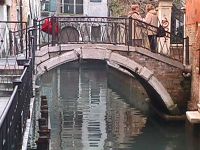
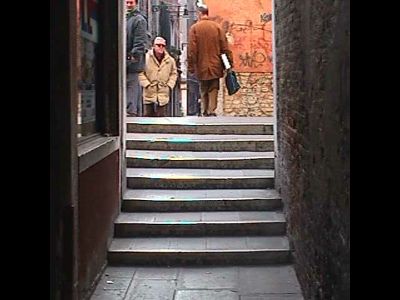
The Ponte del Pistor was built primarily using Mattoni e Pietra d'Istria. It crosses the Rio del Piombo bridging a gap which is 5.45 meters. The bridge is not a crooked bridge. On the northern side of the bridge is the sestiere of Castello and on the southern side is also Castello .There are 2 ramps. On the north side there are 7 steps, on the south side there are 8 steps. This results in a total of 15 steps. The height of a typical step is 11 meters, the thickness of a step is about 48.5 centimeters, and the width of a step is about 1.56 meters.The steps are paved with Trachite e Asfalto. The bridge is not handicapped accessible and it does not have an additional railing. The summit is 4.23 meters wide and 2.52 meters in length for a total area of about 10.66 meters. The summit is paved with Asfalto. Also, this bridge has 1 arch. The bridge's Vuoto Decorato railing is made of Metallo and is about 4.00 meters wide is about 0.93 meters tall. Finally, the bridge protrudes 0.25 meters to the North and 0.5 meters to the South.
History
The following is any history we have regarding the bridge's origins:
�San Lio. Appiedi of this bridge from the shop prestinaio no longer exists. It was once called 'ca' Mocenigo 'grandiose palace for one's neighbor, which originally belonged to Kelso, which was tied by Tommaso Cavazza in 1461 the Brotherhood of Charity, that this was sold in 1487 to Michael Foscari (which the family belongs the coat of arms on the shaft of the inner court sculptor, and finally passed into a branch of the Mocenigo, known as \the Pearl\, \from Zogie\; or to \from Buso ', by virtue of the marriage happened in 1491 between Alvise Mocenigo q. Thomas and Pilgrim Foscari q. Michiel. 'art' Pistori, \as well gl'inviamenti scattered around the city, Venice had two large\ panaterie, \or places fixed for the sale of bread. The one lying on the S. Marco at the 'Campanile', and the other in Rialto, next to the \Beccarie.\ The first consisted of nineteen workshops; twenty-five the second. The \Pistori\ in the last days of the Republic were ascribed to the School of Albanians in San Maurizio , makes known to us as a decree of the Council of Ten, inserted in the \Catastico of Laws on Biave.\ We quote the following passage: \1780 Sept. 5. X. On the Board of Decree abolishing the Sovegno of Lavoranti Pistori in Church of San Matteo di Rialto. All silver and effects of it should surrender to the heads of the downs of St. Mary and St. Gallen of the Albanians in the church of San Mauritio, composed of all individuals of the Art of Pistori, glue their responsibility, in which they have no voice said Lavoranti neither active nor passive. silvers Of these effects must exist and glue them to a sales intangible capital in the public Mint, whose income should serve as some compensation aggravation that art above is assumed to correspond alli Lavoranti in the case of their disease, \etc.. etc.. Catastico In the above, the headings' Pistori of Venice,\ and \Lavoranti Pistori,\ are found different news related to the art of which we are speaking. prestinaio Other shops named it from other routes of Venice.
Location
The bridge is located at the following coordinates:
Latitude: 45.438028° N
Longitude: 12.3384167° E